Coming Housing Policy Changes
CITY GOVERNMENT
On March 10, 2026 the city held a webinar to discuss city strategy for compliance with the Growth Management Hearings Board (GMHB) ruling that our comprehensive plan is out of compliance with the Growth Management Act. The presentation outlined why the ruling occurred, what changes may be required, and how residents can participate in shaping the response.
[AI Generated Image]
You can see the presentation from the webinar here. Or you can watch the entire 100 minute recording here. But if you prefer a reasonably concise written summary of the video presentation, see below.
Why the City Must Update Its Comprehensive Plan
Every city in Washington must adopt a Comprehensive Plan under the state’s Growth Management Act (GMA). This plan guides how a community will accommodate population growth, housing, transportation, utilities, and infrastructure over a long-term horizon.
Mercer Island adopted its latest Comprehensive Plan update on schedule late in 2024, but the plan was appealed by an organization called Futurewise to the GMHB. In August 2025, the Board issued a Final Decision and Order finding that portions of the plan did not adequately address housing requirements under state law.
The ruling does not invalidate the entire plan, but it requires the city to revise parts of it and come into compliance by July 31, 2026. Failure to comply could lead to unpalatable state sanctions including preventing us from collecting certain taxes, denial of opportunities for state grants, invalidation of the comprehensive plan and related regulations, and more.
The Four Issues the City Must Address
The GMHB identified four major areas where Mercer Island’s plan must be improved. These topics formed the core structure of the presentation.
1. Land Capacity for Housing
Cities must demonstrate that their zoning provides enough land to accommodate housing at different affordability levels.
The Board concluded Mercer Island’s analysis did not clearly show how housing would be provided for very low-income and extremely low-income households.
As a result, the city must:
Reanalyze how much housing capacity exists, disaggregating housing capacity by targeted income range
Identify zoning changes where capacity gaps exist
Ensure capacity for households across multiple income levels
2. “Adequate Provisions” for Affordable Housing
Under state law, cities must go beyond simply zoning for housing—they must also adopt policies and programs that make housing actually feasible to build.
The GMHB determined Mercer Island needs stronger strategies to support affordable housing production. These could include:
Financial incentives
Development requirements
Public-private partnerships
Housing subsidies or funding sources
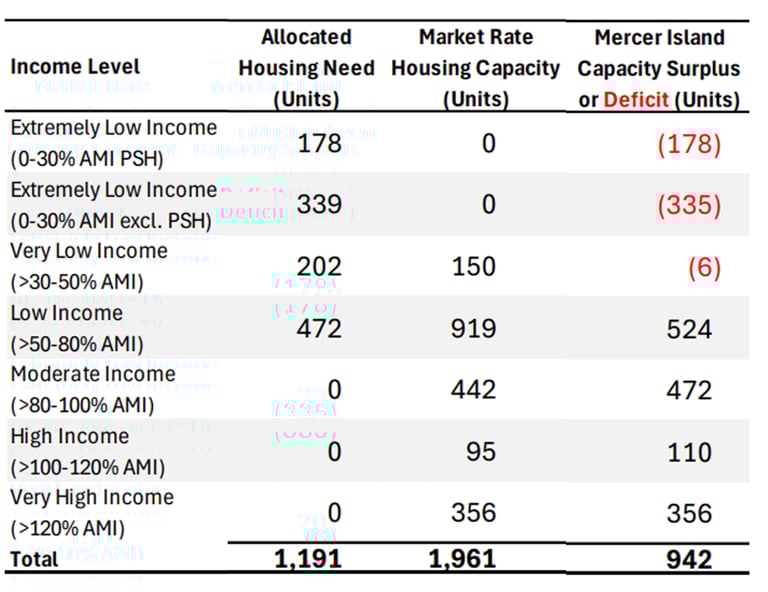
City analysis has identified a potential gap of more than 500 extremely-low-income housing units that policies will need to address, even after we allow for upzoning of town center to eight stories and the nearby multi-family zone to six stories, as shown below. To meet the extremely low income housing need, more than $200 million of suitable housing will need to be constructed on Mercer Island, which could come from partnership with ARCH and/or neighboring communities. There is no State funding included in the mandates to support these construction costs. As a reference, the entire 2026 City budget for the General Fund is $39 million.
3. Station Area Subarea Plan
One of the most significant pieces of work involves planning around the new light rail station opening on Mercer Island as part of Sound Transit’s East Link extension.
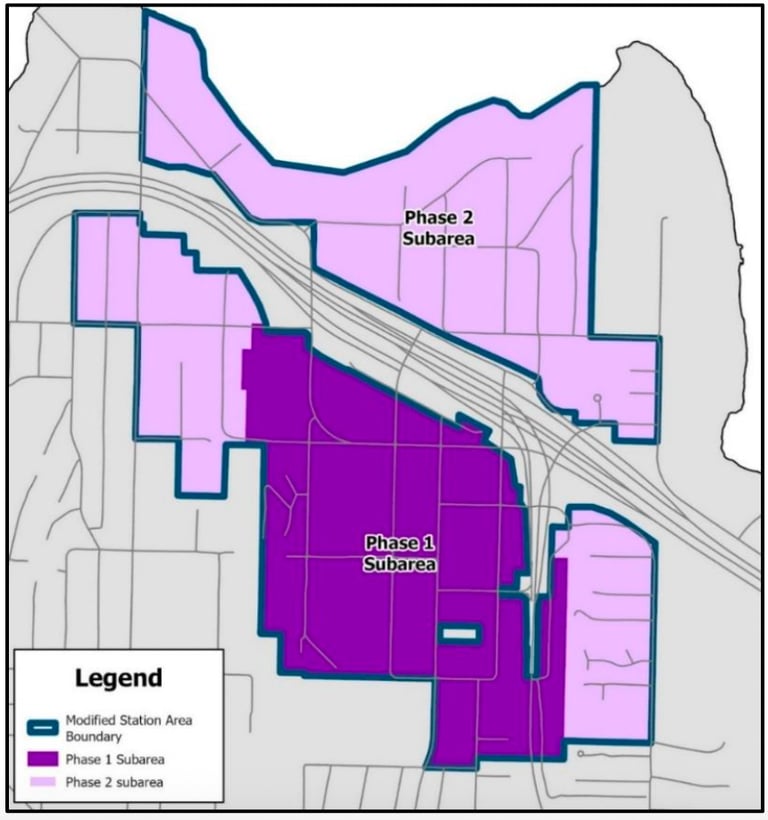
The GMHB order requires the city to adopt a station area subarea plan, covering roughly a ½-mile walking distance around station entrances.
This plan will guide decisions about:
Housing density
Building heights
Transportation and walkability
Infrastructure and public services
Economic development
Because transit-oriented areas often accommodate more housing, the station area may play an important role in meeting housing targets. The Council will be voting on the subarea plan boundaries at the March 17th meeting. The proposed boundary Council will vote on is shown below.
4. Anti-Displacement Measures
Another requirement is to develop policies that help prevent displacement of residents when redevelopment occurs.
When zoning allows higher density, redevelopment can sometimes replace older housing that is relatively affordable. The GMHB therefore directed the city to adopt strategies to reduce displacement risk.
Possible approaches include:
Tenant protections
Affordable housing requirements
Preservation programs for existing housing
Relocation assistance policies
How the Compliance Process Will Work
The presentation outlined a structured process for bringing the city into compliance by the July 31st, 2026 deadline.
Step-by-Step Timeline
Aug 2025: GMHB issues Final Decision and Order
Winter–Spring 2026: City develops policy options and analyses
Spring 2026: Community outreach and public engagement
Late Spring / Early Summer 2026: Planning Commission review
Summer 2026: City Council adopts Comprehensive Plan amendments
July 31, 2026: State compliance deadline
The City emphasized that public input will occur throughout the process.
How State Housing Laws Influence the Process
The presentation also explained that the GMHB ruling is closely tied to broader state housing policies.
A key law shaping the decision is House Bill 1220, which requires cities to explicitly plan for housing across multiple income levels rather than relying on general housing growth projections.
The ruling is considered a major precedent because it clarified how cities must demonstrate that their planning will actually produce housing for lower-income households—not just theoretically allow it.
Why This Matters for Mercer Island
While the ruling focuses on planning documents, it could have meaningful implications for the community over time.
Potential outcomes include:
New housing policies or programs
Zoning adjustments near transit
Increased housing capacity in selected areas
Additional affordability strategies
However, city officials stressed that no final zoning decisions have been made yet. The upcoming policy discussions will determine exactly how the city responds.
It is also unclear how any of this will be paid for. In the presentation, the City Manager stated "I'm pretty sure we are the first city to have done this analysis. And that's partially because we were appealed. So we are the front of the line. And I know other cities will be coming behind us doing this type of analysis. And these numbers are big. We're in to the billions statewide just based on some quick math." She encouraged us to contact our Legislators and City Council members with concerns.
What Residents Can Expect Next
The city plans to continue community engagement throughout the compliance process. Residents will likely see:
Planning Commission hearings
City Council work sessions
Opportunities to comment on proposed amendments
The goal is to develop a plan that both meets state housing requirements and reflects community priorities.
Bottom Line
The GMHB ruling requires Mercer Island to revisit parts of its Comprehensive Plan to better address housing affordability and growth.
To comply with state law by July 31, 2026, the city must:
Reevaluate housing capacity
Adopt stronger affordable housing strategies
Create a station area subarea plan near the light rail station
Develop anti-displacement policies
The coming months will involve policy development, community engagement, and legislative review as Mercer Island works to update its long-term growth strategy.
Learning More
Besides watching the video and viewing the presentation, the best place to learn more is LetsTalk.
Learn more about the Futurewise organization that appealed the City of Mercer Island's plan to the GMHB and its use of legal action to support enforcement of the Growth Management Act here.
Learn more about Washington State's Growth Management Act here.
The City of Seattle submitted their plan nearly a year late -- read about it here.