Councilmember Craig Reynolds Recap - 2026-01-16
OPINIONCITY GOVERNMENT


In this column, Council Member Craig Reynolds shares his perspective on recent issues before the Mercer Island City Council as well as insight in to how he votes and shapes city planning and policies.


First photo of the new Council.
Credit to the selfie-master: Councilmember Julie Hsieh.
January 16, 2026 Council Meeting Update
On January 16, 2026 the City Council held its annual planning retreat. The agenda was broad and ambitious, and the CIty Manager and Mayor decided to defer discussion of AB 6839, Budget Basics and Financial Priorities in 2026, to a later council meeting. See here for more background on the issues on the agenda. See below for a recap of the issues covered today.
AB 6838
The Growth Management Hearings Board (GMHB) decision in the Futurewise appeal of Mercer Island’s Comprehensive Plan left the city of Mercer Island in a difficult position. Some on the Council, like me, feel the City would be a better place to live if we had a greater diversity of housing stock, including more affordable housing. But even those who want more affordable housing find the implications of the GMHB decision to be overwhelming. We are going to be forced to do a lot of planning in a very short period of time—with substantial changes to the Comprehensive Plan by the end of July.
Despite our diversity of opinions, we voted 7-0 on a range of associated motions:
Motion #1: Direct staff to prepare a revised land capacity analysis to evaluate residential land capacity at each housing affordability range and return to the City Council in February 2026 with the analysis.
In effect, this requires staff to redo the plan for 1,239 units to disaggregate into plans for
517 units affordable to those earning less than 30% of AMI (area median income)
202 units affordable to those earning 30-50% of AMI
488 units affordable to those earning 50-80% of AMI
4 units affordable to those earning 80-100% of AMI
5 units affordable to those earning 100-120% of AMI
23 units affordable to those earning more than 120% of AMI
Motion #2A: Direct staff to evaluate aligning compliance with the GMHB Order and HB 1491 (2021 TOD bill) and establish the first follow-up with City Council for February 2026.
HB 1491 is the Transit Oriented Development (TOD) bill. This bill requires the City to dramatically change the housing rules within ½ mile of walking distance from the transit station entrances. Note this will encompass virtually the entire north end of the island. (See photo below.)
Allow an average of 3.5 floor area ration (FAR). (e.g., for an average 10,000 square foot lot, the building floor area must be at least 35,000 square feet, which typically will require at least five stories
Require that a minimum of ten percent of all units must be affordable (at 60% of the AMI for rental housing and 80% of the AMI for owner-occupied housing);
Grant an additional 1.5 FAR for developments that have 100% of units as either permanent supportive housing (units affordable at 0-30% of the AMI) or workforce housing (affordable at 80% of the AMI); and,
Allow multifamily residential and mixed-use development.
The city will have some flexibility to make limited small changes to the border of the TOD area. We are not required to adopt these rules before 2029, but it makes sense to plan now to do this, since it will be a key step in complying with the GMHB ruling.
Motion #2B: Confirm the guidelines for developing the station area boundary and direct staff to return to the City Council in February 2026 with a draft station area map.
These guidelines include
Guideline 1: Exclude city parks, open space, and the Interstate 90 corridor from the station area.
Guideline 2: Exclude areas that would be non-contiguous from the station area after removing city parks, open space, and the I-90 corridor are removed from the station area.
Guideline 3: Align the remaining station area boundary with City streets.
Guideline 4: The station area boundary should follow existing zoning boundaries if City streets do not make a logical boundary.
Motion #3: Direct the staff to finalize a work plan and schedule to implement the policies from the Housing Element of the Comprehensive Plan to address the “adequate provisions” requirements to increase the supply of affordable housing and “anti-displacement policies” to reduce displacement risk. Bring the work plan and schedule to the City Council for review and approval in February 2026.
The referenced policies from our Comprehensive Plan indicated that the city would consider various options for increasing affordable housing. The staff will be bringing forward draft proposed regulations to require these items.
Multifamily Tax Exemption (MFTE) (Policy 2.5.4)
Permit fee reduction or waiver (Policy 2.5.6)
Reduced parking requirements (Policy 2.5.
Fee in lieu of affordable housing (Policy 2.7)
Inclusionary zoning (Policy 2.9)
Motion #4: Direct the staff to evaluate opportunities for direct delivery of affordable housing through a combination of partnerships, fee-in-lieu programs, direct investment, the creation of a Housing Fund, and/or other mechanisms and return to the City Council in March 2026 with a preliminary report.
See this link for the associated city press release. And see letstalk for even more information..
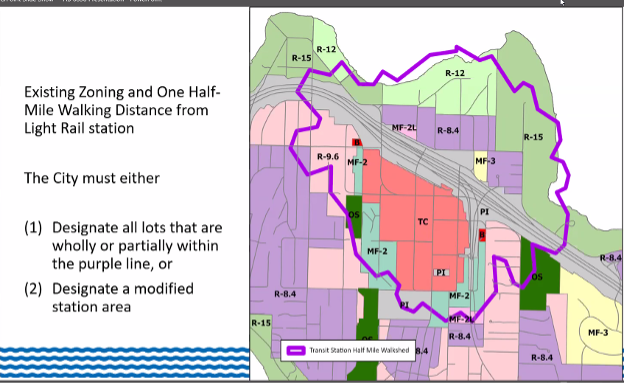
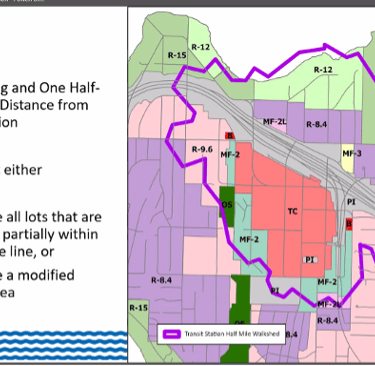
Staff visualization of the area that could be subject to the TOD rules.
AB 6840
The Council had a thoughtful discussion of "what went wrong" with the Public Safety and Maintenance Building bond. The bond was supported by a majority of Islanders, but it did not reach the 60% minimum for passage. The Council was asked to brainstorm on what we learned. Of course, we will know more after the community survey is complete.. But for now, some of the ideas discussed included:
Did the community understand the difference between City Hall and the Public Safety and Maintenance Building?
Was there enough public engagement?
Did residents understand and appreciate how much the city had done to explore town center alternatives?
How much support did we lose because there was a perceived lack of Council support for the school bond?
Was the bond term too long?
Did the community appreciate the importance of a covered facility?
Did the community understand the sorry shape of the extant building?
Could we build a smaller facility if we made better use of the 9655 building?
How many votes did we lose due to the generally poor status of the economy?
Was the city the victim of its own quality work? If service is good, why do we need to change anything?
How do we help the community to understand the importance and benefits of a sustainable (in both senses of the word) building.
Do residents understand how they have benefited from the investments of prior generations, and how could we convince them to make similar investments for the benefit of generations to come?
Was it just too darn much money?
I imagine Council will consider this again once the survey is done. The status quo does not work for the city.
AB 6842
Fan Yuan, a leader of the Mercer Island Chinese Association and community volunteer extraordinaire was chosen as "Community Member of the Year"