Is Mercer Island Town Center Playing Out Of Tune?
OPINIONCOMMUNITY
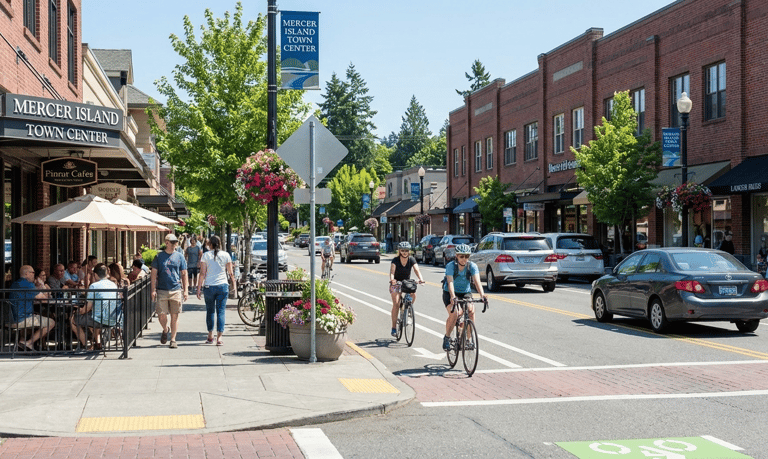
Currently, streets like 77th Ave SE are designed like highways—built to move cars through our community rather than bringing neighbors into it. By rethinking our street design (starting with simple paint!), we can create a "symphony" that works for everyone: safer sidewalks for families, protected lanes for cyclists, and accessible parking for our small businesses. It’s time to design for the many, not the few.
Symphonies are at their best all players are working together…
I don’t think anyone would object to this statement but yet in many scenarios we accept non-team work and think it is OK. We accept solutions to one person’s concerns and forget that there are others that have needs too. This is especially true in communities.
I would like everyone to think about this when it comes to our Town Center “streets”. Unlike a roadway that is built to connect two distinct locations, a street in a Town Center is meant for bringing residents to the Town Center. It is meant to allow them to flow smoothly along and across it to provide for the needs of those that reside along its borders. It is not meant for one mode of transportation nor one particular user but many modes of transportation and many different users.
What this means is that while roads only have a couple of users and concerns to worry about, streets have many and if all are not taken into consideration the street moves from being of value to the community to often being a detriment to the community. Instead of safely transporting users from one location to another they block the safe flow of traffic, harm the retail core and often put residents and the community at risk.
Let me give an example, 77th Avenue SE in Mercer Island’s Town Center. Let’s name the main users of this street: pedestrians, cyclists, automobiles, local retail, retail employees, retail customers, Town Center residents, community services like transportation, law enforcement, fire and utility, visitors to our parks, our Farmers Market... What this means is that for this street to be successful, it has to take into consideration all of these users.
If a Town Center street only meets the needs of just one or two and forgets the others it is like a symphony that is playing out of tune. Instead of producing wonderful music it is driving out the audience needed for its success. Instead of attracting the best of performers, it is making it impossible for anyone to successfully play. No one is winning, especially the concert hall that needs a successful symphony to support it.
77th Avenue SE is designed for transporting higher speed traffic through the Town Center as well as experienced cyclists. It is not well designed for pedestrians and lower skilled cyclists like families and youth. It is not well designed to serve local small businesses, the Farmers Market, park visitors, or anyone other than the first two groups.
This does not have to be. 77th Avenue SE can be designed to serve all just as easily as serving just a few. Correctly designing the street does not mean taking away services for cyclists. Correctly designing the street does not impede traffic flow but I contend it would increase traffic flow and make it safer, for drivers as well as others.
Let’s start with street design basics. Removing the dead center lane on 77th Avenue SE will automatically reduce the width of the street by one third. That is huge. That means a street that is easier to cross. It does not mean getting rid of places for loading vehicles to park because now you have space on the sides of the street for pickup/delivery parking, parking that doesn’t just serve large delivery vehicles but delivery vans and customers that can’t safely use the center lane.
With the extra space on the sides of 77th Avenue SE, you can now add parking. That is not just parking needed so Mercer Island residents can come to the Town Center, but parking that provides a metal barrier to the sidewalk to make it more walkable (safe). Parking also means added friction to the vehicle lanes so drivers go the desired speed, improving safety and vehicular flow to allow more traffic to move on the street. It causes drivers to go from automatic to manual driving mode so they are more aware of their surroundings, like pedestrians and cyclists.
Parked cars in this scenario don’t eliminate bike lanes, but as can be seen on Seattle’s Dexter Avenue North parked cars now help to protect the bicycle lanes. You can also add diagonal parking to just one side and a cycle track on the other for an even better cycling experience especially for families, youth and inexperienced cyclists. This removes all cyclists from the sidewalks improving pedestrian safety.
The final thing that I think it is important to note is that serving all, and not just a few, is less expensive. When you just serve vehicles, you almost always need to install expensive traffic lights, turn lanes and the like but when you design the street correctly, you can just use paint. Street design basics start with paint because street design is an inexact science and this allows you to easily and inexpensively modify the street until you have the perfect design for all.
What we are talking about here is a symphony that plays the most wondrous repertoire. A symphony that everyone wants to listen to. A symphony that doesn’t drive away its audience but brings them to their feet with applause. A symphony that is so successful that it helps you to pay for the other necessities needed for a successful community. This should be beautiful music to everyone’s ears.
Let’s stop designing Town Center streets for just one or two users at the cost of everyone else. Let’s design our streets to meet everyone’s needs. Let’s design streets that don’t shut down our local small businesses but help keep them alive and thriving.
I encourage our city leaders to consider what I have said. Then, form a special task force like the Town Center Stakeholders or Community Advisory Group that has representatives from all groups charged with advising the city on street design. This will bring everyone together to both speak and “listen” to each other so all voices are heard.