Mercer Mayhem on the March
Worried Neighbors Brace For Light Rail Impacts
COMMUNITYOPINION
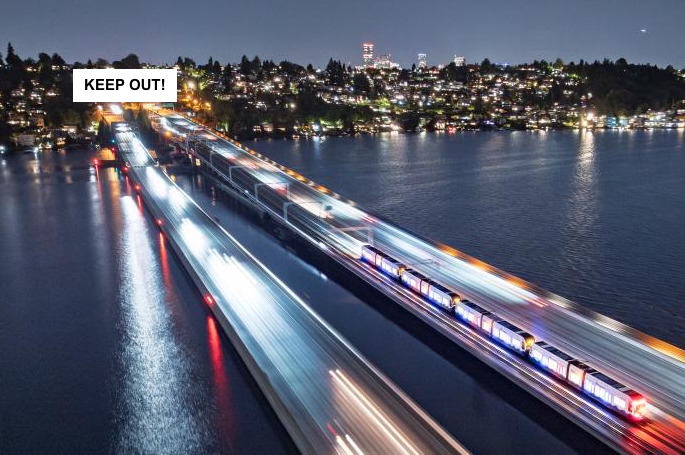
Base Image Source: Sound Transit
As Sound Transit’s long awaited cross-lake light rail project prepares to open on March 28th, 2026, many Mercer Island residents are celebrating their newfound mobility, planning trips to downtown Seattle and Bellevue as well as previously inaccessible, bucket-list destinations like Lynnwood and Angle Lake.
But not everyone is thrilled. Neighboring communities are nervously bracing themselves for an influx of free-ranging Islanders. Traffic, crime, and intensified competition for prime brunch spots lead the list of fears voiced by Seattleites about the new “invasive species.”
“We don’t know quite what to expect,” Seattle Police Chief Carlene Free told a crowd of concerned community members at Thurgood Marshall Elementary School on Wednesday. “We’re hoping for the best, but preparing for the worst.” Chief Free’s announcement of extra patrols at stations along the Line 2 route from Mercer Island did not mollify everyone, however.
Rita Payne, a homeowner in Seattle’s Central District, is excited about the new light rail station at nearby Judkins Park – but concerned about the clientele it may attract from across the lake. “It used to be that to get here from a place like Mercer Island, you needed to have a car,“ she told Talk On The Rock. “That required a certain amount of resources.” Now, with nothing but a $3 fare separating Island dwellers from the temptations of city life, Payne frets that “the floodgates are open – and my neighborhood is about to get wet.”
Many worry about Island youth. Raised in an isolated community without any real consequences for misbehavior, young people on the Island “often act out against the norms of the larger society,” warns former Director of Home Island Security Odysseus Wrath. Despite the availability of drivers’ licenses and (reportedly) the occasional bus, Wrath says, Lake Washington has largely kept their hijinks contained. Until now.
Others raise equity issues, noting that while Island residents are getting access to museums, theaters, concerts, professional sports, shopping, restaurants, bars, transportation hubs, parks, tourist attractions, schools, universities, hospitals, courts, government services, and a plethora of jobs in every industry, the rest of the region is not receiving as much in return for its light-rail investment on Mercer Island. “I hear the Park-and-Ride lot is worth visiting, particularly at peak times,” commented David Bluster, editor of 98101 Places in Seattle You Cannot Miss Upon Pain of Death, a popular guidebook. “Other than that, I’m not sure why anyone would go there.”
Not everyone thinks the prospect of invading Island hordes is all bad. Some mainland businesses even think they could be a net positive.
Long Lanh, owner of a popular phở restaurant in Little Saigon, says customers from the Island are welcome in his establishment. “They get here early, they eat quickly, they go home. They’re asleep in their beds before our regular customers come in. So, it’s really not much of a problem at all.”
“Mercer Islanders are not without resources,” notes Milton Freewater, an economist at the Recovery Institute, a Renton think tank. “In fact, given the lack of shops, restaurants and other amenities in their own community, many have accumulated substantial savings.”
Yet other businesses are girding for impact. The Port of Seattle projects a deficit this year as Sea-Tac parking revenues suffer from lost Mercer Island traffic. “Island people have been reliably filling our pockets for years,” notes Port Commissioner Steven Dore. “If they start taking the light rail to the airport, it will be a big hit. We may even have to convert some of our garages to housing.”
Similar concerns are shared by parking lots, luxury auto dealerships, shopping malls, and gas stations across the region. “Light rail is incredibly disruptive not only to our businesses, but to an entire way of life,“ claims Phillip Hupp, spokesperson for the Burien-based pro-driving organization Fossil Facts. The group has been lobbying the legislature to tax light-rail riders to compensate affected businesses and to preserve traditional parking areas. “It’s part of our heritage,” Hupp says. “Once parking spaces are lost to other developmental uses, they are lost forever.”
On the other side of the lake, different concerns prevail. Semper Freebird III, proprietor of the Bellevue Exception, an upscale shopping mall, long battled against the extension of light rail across Mercer Island. Now, he is resigned to it. But he worries about shoplifting by Island kids. “They’ll walk right out of stores with armloads of clothes and never think to stop at the register.” When they arrive by car, he explains, their parents usually follow them around with credit cards. “All that will change with light rail,” he says.
Experts are urging patience. “The Island peoples have been isolated for a long time,” according to University of Washington sociology professor Claude Levi-Stadium. “Re-integrating them with the rest of society is going to take sustained work and substantial public resources.”
Social-justice advocates caution that mainlanders should not assume Mercer Islanders share their cultural experiences and expectations. “This is an entire community of 25,000 souls, isolated for decades in the center of a major metropolitan area -- with what, one stop light?” remarked Juana Spann-Aguas, King County’s newly appointed Deputy Coordinator of Interbridge Mental-Wellness Services. “You can’t just set them down on Broadway or the Ave and expect that they will know how to behave in an urban environment. And yet that is exactly where light rail will take them.”
Spann-Aguas is particularly worried that Islanders will feel vulnerable venturing forth in other communities without their cars. “The automobile has served as a kind of protective shield for generations of Islanders when they ventured to the mainland to forage or to perform rituals, somewhat analogous to the shell of a turtle.” When urban street life became too intense, she observed, Islanders could retreat to their cars as a place for calming and recuperation. “That’s just not available with light rail,” she warns. “It could make for a volatile situation.” She urges people to be cautious around distressed Islanders, and to offer them shelter in parked vehicles when not in use.
Others warn against looking at the newcomers through a stereotypical lens. “Everyone has an image of what a Mercer Islander is like,” Levi-Stadium says. “This ignores the surprising diversity of the community. South End people, for example, can differ remarkably from their North End cousins. “They have different habits, customs, and migratory patterns,” he observes. Some North Enders have even considered themselves as living “practically in Seattle” while South Enders have been more isolated.
Light rail could make this division even more pronounced. “We could see North Enders increasingly integrated into metropolitan life,” Levi-Stadium thinks, “while South Enders retain more of their traditional ways.” This may even threaten the political unity of the Island, which has been stable since the dissolution of the separate junior high schools maintained by North and South prior to 1982.
Islanders themselves seem little aware of the anxiety with which they are awaited in the surrounding region. “I’m just looking forward to causing some trouble,” said Marpy Hone, 16, an MI youth who requested anonymity in order to commit property crimes with impunity while still a minor. “There are a lot of soft targets out there -- and with light rail I can no longer be stopped or even slowed by traffic.”
Time will tell whether the cautious pessimists or the extreme pessimists were right. The only sure thing is that after March 28th, the Island – and its neighbors – will never be the same.
About the Author:
Dean Falvy is a graduate of North Mercer Junior High School and Mercer Island High School. He Escaped from the Rock and now practices law in Seattle, where he also teaches courses at the University of Washington School of Law. This column does not constitute legal advice. If you rely upon it as such, that’s your bad.