Councilmember Craig Reynolds Shares Meeting Recap 2/17/26
CITY GOVERNMENT
In this column, Council Member Craig Reynolds shares his perspective on recent issues before the Mercer Island City Council as well as insight in to how he votes and shapes city planning and policies.
February 17, 2026 Council Meeting Update
Another Mercer Island City Council meeting is a wrap.
On February 17, 2026 the City Council had its regularly scheduled meeting at the Mercer Island Community and Event Center. Councilmember Anderl and I attended remotely. All other councilmembers attended in person. Key agenda items included:
AB 6865: Compliance with Growth Management Hearings Board Final Decision and Order related to the City of Mercer Island Periodic Update to the Comprehensive Plan
AB 6866: GMA Compliance Public Engagement Plan
AB 6871: Legislative Review Alternatives to Help City Meet GMHB Order Compliance Deadline (Ordinance No. 26C-03 First Reading)
The meeting agenda addressed a variety of housing topics that will impact Mercer Island in Extraordinary ways, but the Council agreed unanimously in every vote.
If you would like to learn more about these topics, see here for the staff presentation from the City Council meeting. Or, see the letstalk page for more information still. Or. attend future City Council meetings or the upcoming (not yet scheduled) community information session.
AB 6865: Compliance with Growth Management Hearings Board Final Decision and Order related to the City of Mercer Island Periodic Update to the Comprehensive Plan
As a result of the Growth Management Hearings Board (GMHB) decision on Future Wise’s appeal of Mercer Island’s Comprehensive Plan, the City must amend its Comprehensive Plan to address the following four issues by the end of July.
Land Capacity: Analyze residential land capacity at each housing affordability level and close any identified gaps.
Adequate Provisions: Adopt incentives, mandatory provisions, and planned actions (“aka adequate provisions”) that will increase the supply of affordable housing.
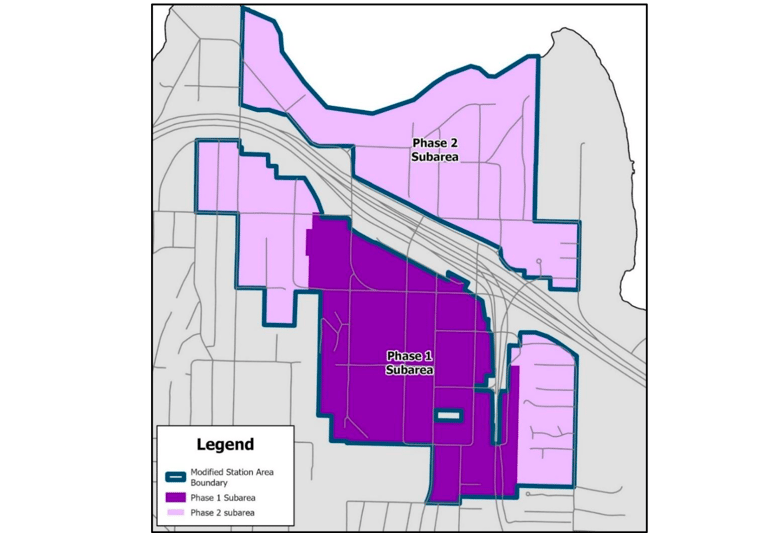
Station Area Subarea Plan: Adopt a subarea plan for the area around the transit station.
Anti-Displacement Measures: Adopt anti-displacement measures to address the potential displacement that can occur with changes in zoning.
Staff and Consultants to the city have been studying the issues related to this ruling and have come up with the outline of a plan to respond. The City is breaking new ground here, as we are the city named in the appeal, and, as such, we are being forced to accept an interpretation of state requirements that other cities are not yet being forced to do. In short, we must have a plan to credibly facilitate 1,207 units of affordable housing, 517 of which must be affordable to households earnings less than 30% of Area Median Income. My understanding is that the plan will not force building the housing, but if progress has not been made at our five-year check in, we may be forced to take further actions.
The details and derivation of the plan are highly technical, but at the end of the day what matters is the outcome. Under this plan, the height limit in town center will increase to eight stories, and the limit in multifamily areas adjoining town center will increase to six stories. This increase will credibly allow inclusionary zoning (mandatory creation of a modest amount of affordable housing as a condition of building permits) and market rate housing that would address all of the housing shortfall other than the 517 units destined for people earning less than 30% of area median income.
Plans for that lower 30% remain to be fleshed out. Ultimately, the city might need to come up with between $66 and $109 million dollars in cash or land that could be paired with ARCH money or other sources to fund construction of $264 million to $311 million in affordable housing for this segment of the population.
Around $31 million of this city contribution might come from a fee in lieu program, in effect a fee charged to builders of market rate housing. Time will tell where the rest might come from. Certainly, the city does not currently have the resources to even put a dent in this amount.
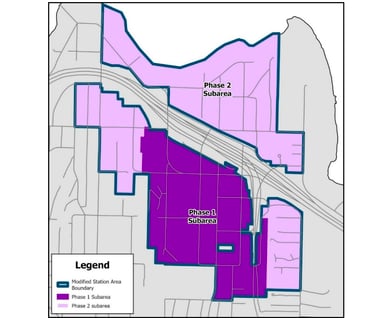
Staff also outlined their proposed vision for that portion of the City that will be designated as a transit subarea. See photo above. We will be pursuing a two-phase plan to write the rules for this area, with the first phase targeted for completion by the July 31 deadline.
The following City Council actions are approved 7-0:
Direct staff to pursue compliance with the GMHB Order under “Scenario 1” as described within the agenda bill, whereby upzones and resulting development capacity increases would be limited at this time to the existing Town Center and adjacent multifamily zones, and implementation of the TOD bill will be pursued as a second phase of work.
Direct staff to open a public feedback period through March 13, 2026 on the Preliminary Station Area Boundary Map and provide the feedback to the City Council at the March 17, 2026 City Council meeting.
AB 6866: GMA Compliance Public Engagement Plan
The council also approved a community outreach plan to start educating community members on all of these housing related issues. The city manager acknowledged that the challenges of communicating such a complex topic to abroader audience will be substantial.
AB 6871: Legislative Review Alternatives to Help City Meet GMHB Order Compliance Deadline (Ordinance No. 26C-03 First Reading)
The council discussed several options for speeding up the policy work to meet the schedule imposed by the GMHB. We unanimously agreed to:
Direct the City Manager to develop clear hand-off instructions and legislative review deadlines to be included in the comprehensive plan legislative review transmittal memo to the Planning Commission.
Schedule Ordinance No. 26C-03 for second reading and adoption at the next possible City Council Meeting.
This latter ordinance moves the process for approval of site-specific rezones from the planning commission to the Hearing Examiner. This will bring us into better alignment with cities around the region and create more capacity for the planning commission to pursue the GMHB work.
Councilmember Reports
I reported out on two issues. First, I warned the Council that the Deane’s Children’s Park site plan does not yet have broad consensus within the Parks and Recreation Commission. It may take some work to get unanimous agreement on the related hand off memo to council.
I expressed my hopes for the safety of community members, given regional ICE activity. With this in mind, I reminded the Council of our June 10, 2020 diversity statement that proclaimed our
continuing commitment to be an inclusive community that rejects stigma and bias against individuals because of race, ethnicity, place of origin, physical ability, socio-economic status, gender identity, sexual orientation, age or religion, and
urged
all our members and residents of our community to treat each other with respect and work together to overcome all expressions of hate and bigotry.
Councilmember Weiker updated the Council on actions of the Renton Airport Advisory Committee.
Councilmember Weinberg reported out on the Eastside Transportation Partnership, including a discussion of the light rail “2 line” test runs, and the upcoming groundbreaking for the "3 line" to Kenmore and Bothell. He also mentioned his upcoming open brunch, at Sushi Joa on Saturday at noon.
Councilmember Anderl mentioned the recent meeting of the Open Space Conservancy Trust, who will shortly be making their annual report to Council.
Councilmember Hsieh reported on several issues:
Today marks the beginning of the Year of the Fire Horse, which is supposed to be a period of progress, action, and change.
Today is also the beginning of Ramadan.
The MIYFS Foundation breakfast was a big success.
The school levy renewal passed.
She has an upcoming community coffee at ASA at 11:00 AM on February 25.