Councilmember Craig Reynolds Shares Meeting Recap: 2026-03-03
CITY GOVERNMENT


In this column, Council Member Craig Reynolds shares his perspective on recent issues before the Mercer Island City Council as well as insight in to how he votes and shapes city planning and policies.
March 3, 2026 Council Meeting Update
Another Mercer Island City Council meeting is a wrap.
On March 3, 2026 the City Council had its regularly scheduled meeting at the Mercer Island Community and Event Center. All seven councilmembers attended in person. Key agenda items included:
AB 6893: Compliance with Growth Management Hearings Board Order – Follow-Up Discussion on Financing Affordable Housing
AB 6880: Public Hearing on Interim Regulations in MICC 19.16.010 Related to Emergency Shelters and Housing, Transitional Housing, and Permanent Supportive Housing (Ordinance No. 26-02, First Reading)
AB 6881: Review of City Facility Strategy Community Survey Results
AB 6872: Sustainability Work Program Annual Update
AB 6836: Electric Vehicle Charging Plan Development Update
You can offer feedback on this or any city policy issue via email to citycouncil@mercerlsland.gov. If you have an issue with city services rather than policy matters, email to customerservice@mercerisland.gov.
AB 6893: Compliance with Growth Management Hearings Board Order – Follow-Up Discussion on Financing Affordable Housing
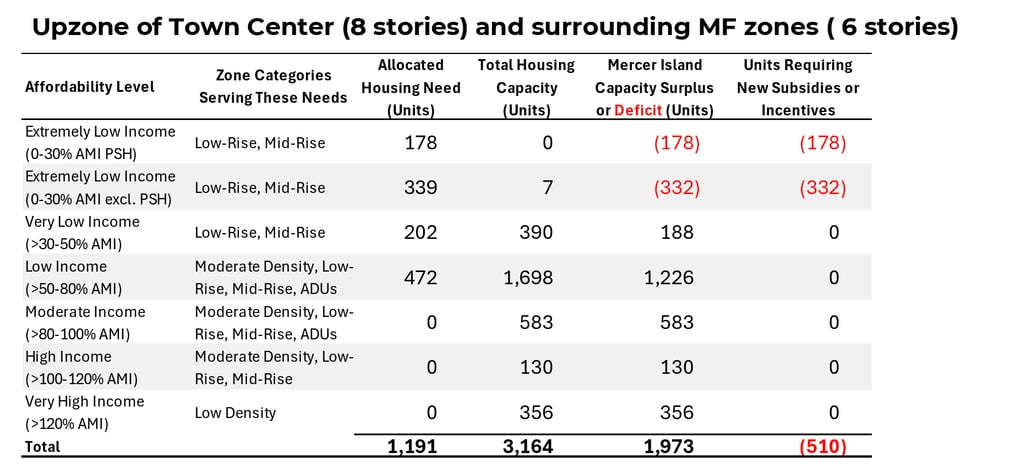
This study session was a follow up on discussions at the prior meeting related to compliance with the Growth Management hearings Board ruling. Through upzoning in town center (to be 8 floors) and the nearby multi-family zone (to be 6 floors) we can make “adequate provisions” for housing at all tiers of affordability other than at the lowest levels of affordability, with a shortfall of 510 units of “extremely low income” housing, as shown in the table below.
So we are left struggling to find a solution to fill that need. Staff and consultant analysis suggests that:
Market forces will not create housing at this level of affordability.
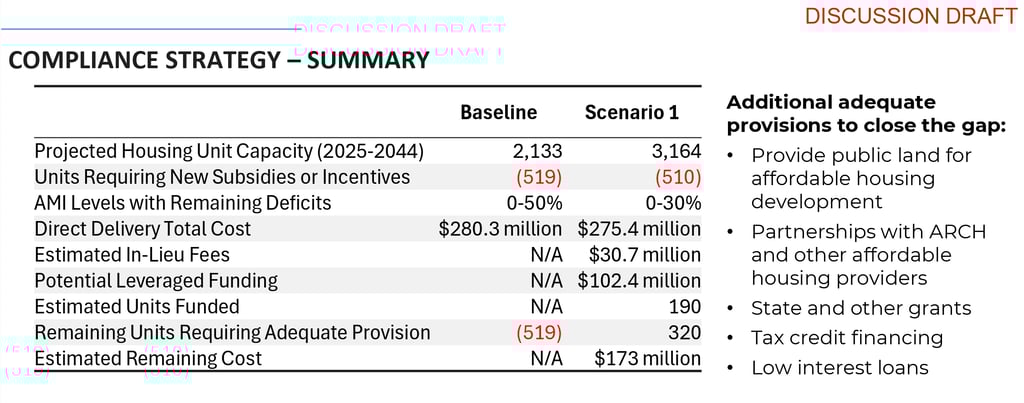
Through a “fee in lieu” program, we can assess fees of $25 /sq ft on new housing construction, which couls generate about $31 Million to provide seed funding for affordable housing construction.
By working with a partner entity like ARCH, this $31 million can turn into $102 million of leveraged funding. (In other words, $31 million can be used as a down payment on a loan to secure another $71 million of capital.)
This fund could produce 190 units of extremely low income housing at a cost of about $510 thousand to $600 thousand per unit.
This leaves a shortage of 320 units (or $173 million) that we still need to find a solution for. As noted below, we can work on plans to fund this with ARCH partnerships, land donations, state or federal grants, or other options. Either way, a substantial hole remains to be filled.
AB 6880: Public Hearing on Interim Regulations in MICC 19.16.010 Related to Emergency Shelters and Housing, Transitional Housing, and Permanent Supportive Housing (Ordinance No. 26-02, First Reading)
This agenda item was a routine extension of temporary rules related to allowing Emergency Shelters, Transitional Housing, Emergency Housing and Permanent Supportive Housing (STEP) in Town Center and Residential zones. We are currently required to allow such housing on the Island as a result of HB 1220. Some types of STEP housing has been allowed on the Island for decades. These temporary rules were adopted in 2022 and have been renewed every six months since then. This time is no different. Temporary rules were adopted as needed to keep up with a high volume of new housing regulations from the state in recent years.
Some community members noted that the temporary rules allow emergency shelters and emergency housing in residential zones, when they are only required to be allowed in town center. This is true, but this has been the case since at least 2022. This issue will be examined as the permanent rules are developed and adopted later this spring. For now, the council renewed the temporary rule to stay in compliance with the requirements of HB 1220.
AB 6881: Review of City Facility Strategy Community Survey Results
Following city failure to get 60% of the vote on our recent public safety and maintenance building bond, the city commissioned a survey to get further community feedback. In my notes going into this meeting I documented some of the key takeaways. This presentation walked through the survey results in a little more detail, though there were few important new insights that I did not cover already.
We did have an interesting discussion about this slide where it seems internally inconsistent that only 54% of the Island thinks the city is “using tax dollars responsibly", while 69% - 78% (depending on the specific question) thinks the city is doing a good job. Apparently a lot of us think the city is providing good services, but they just do not know for sure that the city is doing it cost effectively.
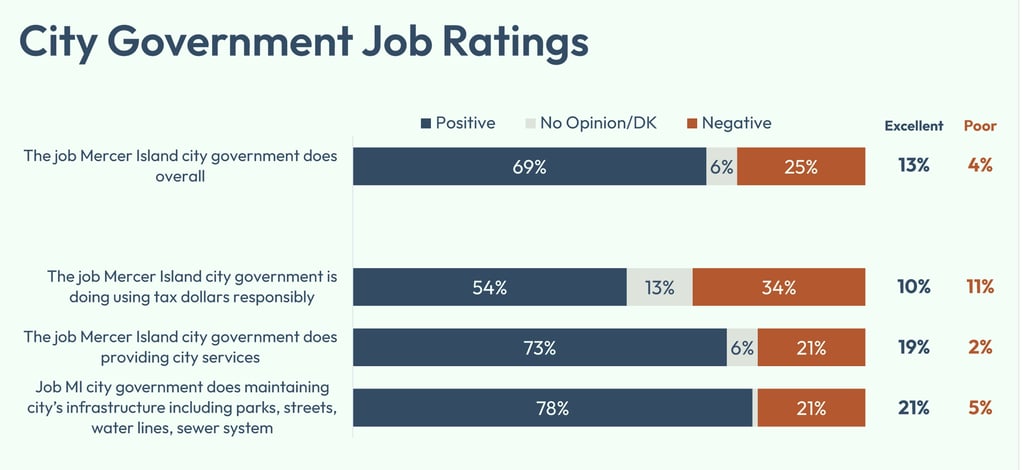
The overall conclusion to draw from the survey seems to be that Island voters support a new building, but they want it to cost less. This will be the City’s challenge.
AB 6872: Sustainability Work Program Annual Update
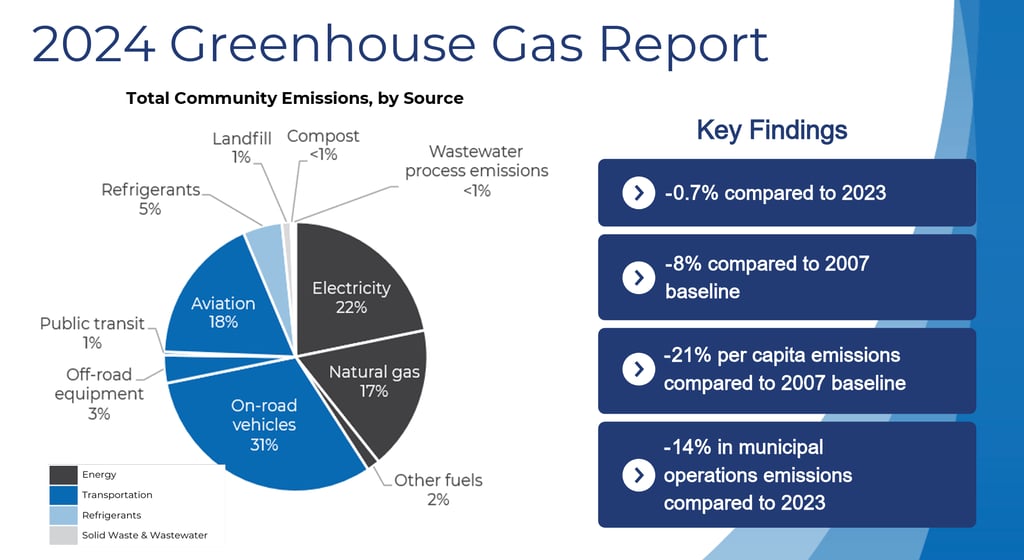
The city continues to make progress on the Climate Action Plan, as recapped below.
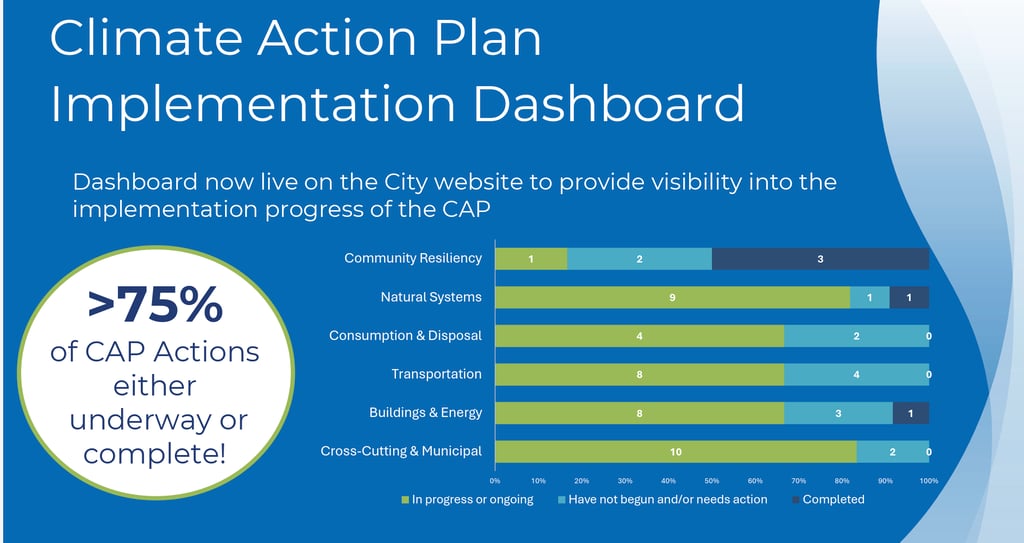
But we are not where we need to be. Our goal is to reduce Greenhouse Gas emissions 50% by 2030, 75% by 2040, and 95% by 2050. But so far we are down less than 1% since last year and only about 8% since the 2007 baseline.
To get where we need to be, as a society, we will need to collectively:
Continue to make our electricity supply more green. (Solar, wind, etc)
Convert more home heating and cooling to electric heat pumps.
Drive less
Fly less
AB 6836: Electric Vehicle Charging Plan Development Update
This presentation was an update from staff and consultants on an EV charging plan. It addressed the need to update city infrastructure to support a gradual electrification of city fleet vehicles and preliminary planning to more public chargers on the Island. The site of the former city hall and the current maintenance building have enough power service—we just need to get the chargers installed. But this will likely wait until we have a new maintenance building constructed so that we can coordinate those efforts. As a reminder, consultant analysis showed that the total cost of ownership (after allowing for “fuel” and maintenance) is LOWER for electric vehicles than for gasoline or diesel vehicles.